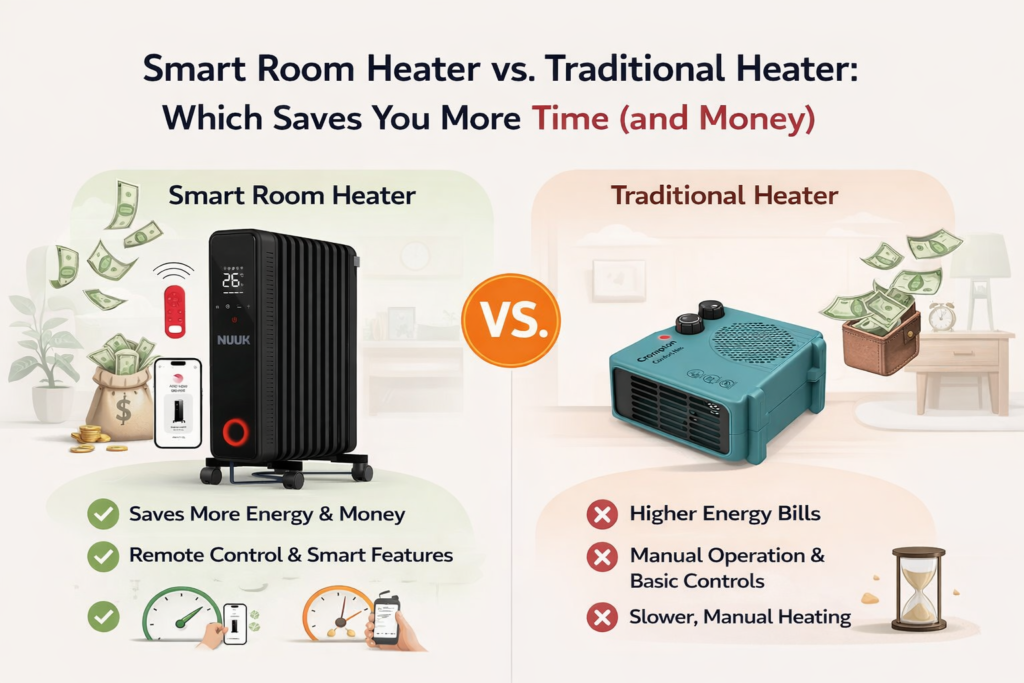
Winter mornings mean dragging yourself out of bed into a freezing room, or coming home to a chilly house after a long day. Traditional heaters force constant adjustments and rack up huge energy bills from running all day. Smart room heaters fix this with app control, auto-scheduling, and precise thermostats, saving up to 30% on electricity while giving back hours of your time.
In 2025, searches for “smart room heater vs traditional heater” spike 40% during November-December, driven by rising energy costs and smart home adoption. With the global smart room heater market growing at 11.5% CAGR, models with WiFi and voice control dominate Amazon best-sellers. This post breaks down why smart wins for time and money, backed by real user stories.
How Smart Heaters Crush Common Pain Points
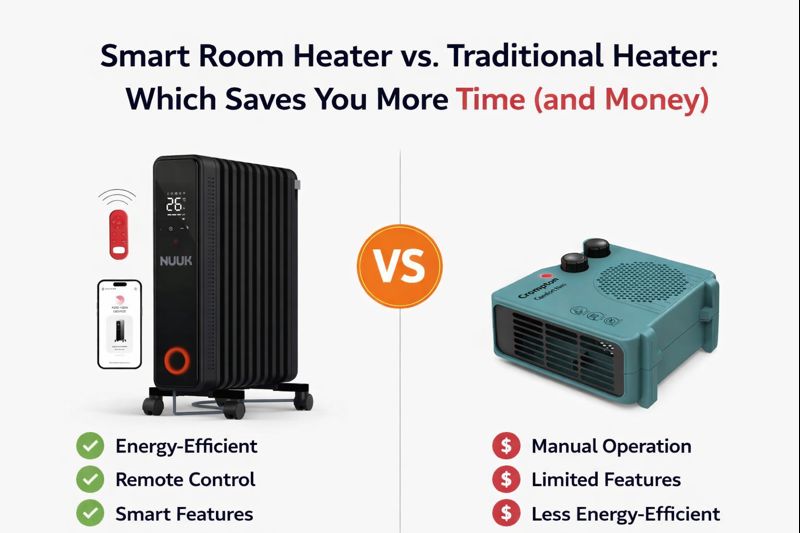
Traditional heaters drag you down with everyday hassles—smart ones wipe them out. Here’s a breakdown tailored to real winter woes:
These fixes align with 2026 trends like geofencing and AI thermostats, turning pain into seamless warmth.
Feature Face-Off: Smart vs. Traditional
Smart heaters pack 2026 PTC ceramics and IoT for zoned magic; traditional stick to coils/oil. Side-by-side:
WiFi holds 64% market share with Matter for smart ecosystems.
Top Smart Room Heater Picks for 2026 Amazon
smarthomesbee focusing on smart home tech, these align with your gadget promo style—WiFi integration for remote workers and energy savers.
- NUUK HÖT BLOX Smart OFR:
- PTC Room Heater for Home Fast Heating with Humidifier 1500/2000 W:
- Orient Electric APTC Smart :
- Crompton COMFORT NEO Room Heater:
- Orpat OEH-1220 2000-Watt Fan Heater:
- Havells Cozio Nuo Room Heater
Best Room heaters in India 2026 Amazon
Traditional heaters suit budget buyers or non-smart homes—reliable basics without apps.
Radiant Heaters
- Orient Electric Quartz: Efficient 800W quartz room heater with Nichrome element for quick, even radiant heat and dual 400W/800W settings.
- Crompton Comfy Plus: 800W quartz heater featuring nickel chrome grill, shock-proof body, dual heat settings, and tilt protection for safe use.
Convection Heaters
- Orient Convection Heater: Powerful 2000W convector with dual fans and adjustable stand for faster, customizable room heating.
- Orpat Convection Heater: Lightweight 2000W convector heater that quickly warms small rooms with adjustable thermostat and safety cut-off.
- Solimo Convection Heater: Amazon’s 2000/1000W model with adjustable thermostat, 10ft air throw, and versatile vertical/horizontal placement.
- Crompton Convection Heater: 2000W heat convector with blower, overheat protection, low power use, and rapid heating for small rooms.
- Havells Mica Room Heater 2000W: Micathermic 2000W convection heater offering rapid, multi-directional heat with noiseless operation and safety features.
Oil Heaters
- Havells Oil Heater 9 Fin: 2400W 9-fin oil-filled radiator with ergonomic design, retractable wheels, and dual heating for efficient full-room warmth.
- Morphy Richards Oil Heater 9 Fin: 2400W 9-fin OFR with PTC fan, adjustable thermostat, three heat settings, and castor wheels for mobility.
- Bajaj Majesty RH 13 Fin: 2900W 13-fin oil-filled heater with PTC fan, three heat settings, tilt safety, and auto thermal cut-off for safe operation.
Best Traditional Room Heaters on Amazon 2026
Traditional heaters suit budget buyers or non-smart homes—reliable basics without apps. Top Amazon sellers for “best traditional room heaters” (high volume, 4.5+ stars):
- Bajaj Majesty RH 11 2000W Coil Heater : Fast coil heat for small rooms, 3 settings, portable. No frills, durable for garages—top budget pick.
- Havells OFR 11 Fin Oil-Filled Radiator : 2900W, 11 fins for even warmth, PTC fan boost. Quiet, no dry air—ideal for bedrooms without smart needs. .
- Usha 2 Rod Quartz Heater : 2000W infrared, wall-mount option, safety grill. Quick heat for living rooms, low upfront cost.
These lack smart savings but excel in simplicity—pair with timers for basic efficiency
Frequently Asked Questions
Do smart room heaters save money vs traditional?
Smart room heaters save 20-40% on bills through scheduling and thermostats that prevent overuse, dropping typical monthly costs from $50 to $25 for a 1500W unit running 4-8 hours daily. Traditional heaters run constantly without smarts, wasting power on empty rooms. This makes smart ideal for energy-conscious users like remote workers.
Smart vs oil-filled efficiency?
Both convert electricity to heat at nearly 100% efficiency per watt, but smart heaters stop waste with features like open-window detection and auto-off. Oil-filled traditional models retain heat longer yet lack controls, leading to higher overall usage. Choose smart for adaptive savings in variable conditions.
Safe for kids/pets?
Smart heaters offer top-tier safety with tip-over shutoff, overheat protection, and app-based remote monitoring to check status instantly. Traditional ones have basic fuses but no remote checks, risking forgotten operation. Parents and pet owners gain peace of mind with smart’s multi-layer safeguards.
Best for home office 2025?
Dreo or Atomi excel with zoned app-controlled heating, pre-warming desks via WiFi without whole-house waste—perfect for 8+ hour sessions. They integrate with Alexa for voice tweaks, saving time over manual traditional adjustments. Aligns with remote worker needs for efficiency and comfort.
WiFi vs Bluetooth?
WiFi enables true remote control from anywhere via internet (64% market share in 2025), while Bluetooth limits to nearby range. WiFi suits smart home ecosystems like Alexa/Google. Go WiFi for flexibility in modern setups.
Payback time?
Smart heaters recoup extra upfront cost ($20-50 more) in 3-6 months through 50%+ energy cuts at $0.15/kWh rates. Daily scheduling halves runtime versus traditional overuse. Long-term ROI favors smart amid rising bills.
Quietest for bedrooms?
Atomi PTC models run at 35-40dB—near-silent like a whisper—thanks to advanced fans and oscillation. Traditional fan heaters often exceed 50dB, disrupting sleep. Ideal for light sleepers seeking cozy nights.
2025 trends?
Matter protocol unifies smart ecosystems, AI learns habits for auto-optimization, and sub-1kW models boost efficiency for desks. These drive portability and integration. Expect infrared-PTC hybrids dominating Amazon.
Traditional vs smart for small budgets?
Traditional like Bajaj offer low upfront savings ($30-50) and simple reliability for basics, but lack long-term efficiency. Smart provides better ROI despite higher initial cost through bill cuts. Budget users start traditional; upgrade smart plugs for the above smart one for sustained value.
Swap traditional for smart this winter—save time and cash via smarthomesbee.com https://smarthomesbee.com/. Stay toasty!